
Maslaha Briefing 3 - The Hidden Lives of Muslims in Prison
This is the third in a series of briefings from Maslaha on the hidden lives of Muslims in prison. The briefings highlight the daily experiences of Muslims in prison and the different forms of harm they face. The third looks at adjudications (punishment) procedures and it shows that:
Prison rules are being applied more harshly and in a discriminatory way against Muslims than non-Muslims
Muslims are less likely to be considered for jobs and education schemes in prison, and more likely to have additional days added to their sentence
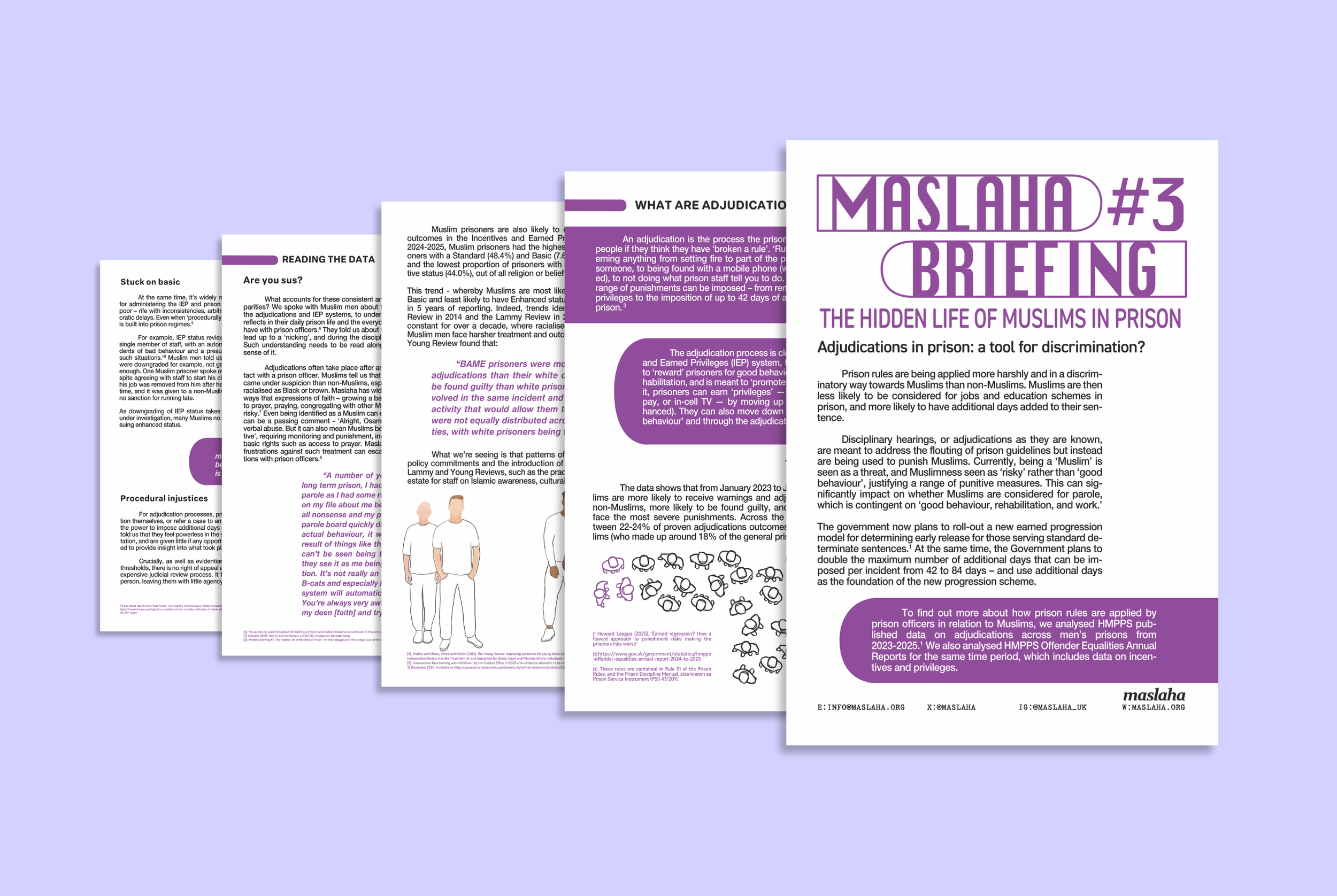
Disciplinary hearings, or adjudications as they are known, are meant to address the flouting
of prison guidelines but instead are being used to punish Muslims. Over the last decade, the
Young (2014) and Lammy (2018) Reviews found that BAME prisoners were more likely to
receive warnings and adjudications than their white counterparts, were more likely to be
found guilty than white prisoners even when they had been involved in the same incident,
and are less favoured for opportunities for purposeful activity to would allow them to work
towards enhanced status.
To find out more about how prison rules are applied by prison officers against Muslims, we
analysed HMPPS published data on adjudications across men’s prisons from 2023-2025. [1]
We also analysed HMPPS Offender Equalities Annual Reports [2] for the same time period,
which includes data on incentives and privileges (IEP) – the ‘reward and penalty’ system for
so called good and bad behaviour which is meant to ‘promote safety and discipline’.
Alongside this data, we spoke with Muslim men about their experiences of the adjudications
and IEP systems, to understand how the data reflects in their daily prison life and the
everyday interactions they have with prison officers.
It shows how everyday injustice is built into prison regimes: with Muslims being labelled
‘disruptive’, requiring monitoring and punishment, with adjudication processes and the IEP
system are becoming vehicles for more subtle – but material - forms of discrimination and
racism to take place.
The more serious adjudication outcomes - cellular confinement, additional days, and loss of
privileges such as access to education and jobs – alongside the adjudication itself, can have
devastating consequences on sentence reviews and parole hearings.
As the government brings in new measures under the Sentencing Act, including a ‘earned
progression’ model, these long term disparities in adjudication outcomes should be sparking
much greater scrutiny than they currently are. Without serious consideration of existing
procedures and accountability mechanisms, more and more Muslims and other Black and
brown people risk being left behind in prison.